 Alexander Sterling
By Alexander Sterling | Editor-in-Chief, MAXIM Fashion
In the world of extraordinary automobiles, few machines manage to combine engineering excellence, timeless design, motorsport heritage, and exclusivity quite like a Ferrari. Yet even by the standards of Maranello, the Ferrari Daytona SP3 occupies a category of its own. With its sculpted bodywork, naturally aspirated V12 engine, and unmistakable connection to the marque’s racing history, this limited-production supercar has become one of the most compelling modern Ferraris for collectors.
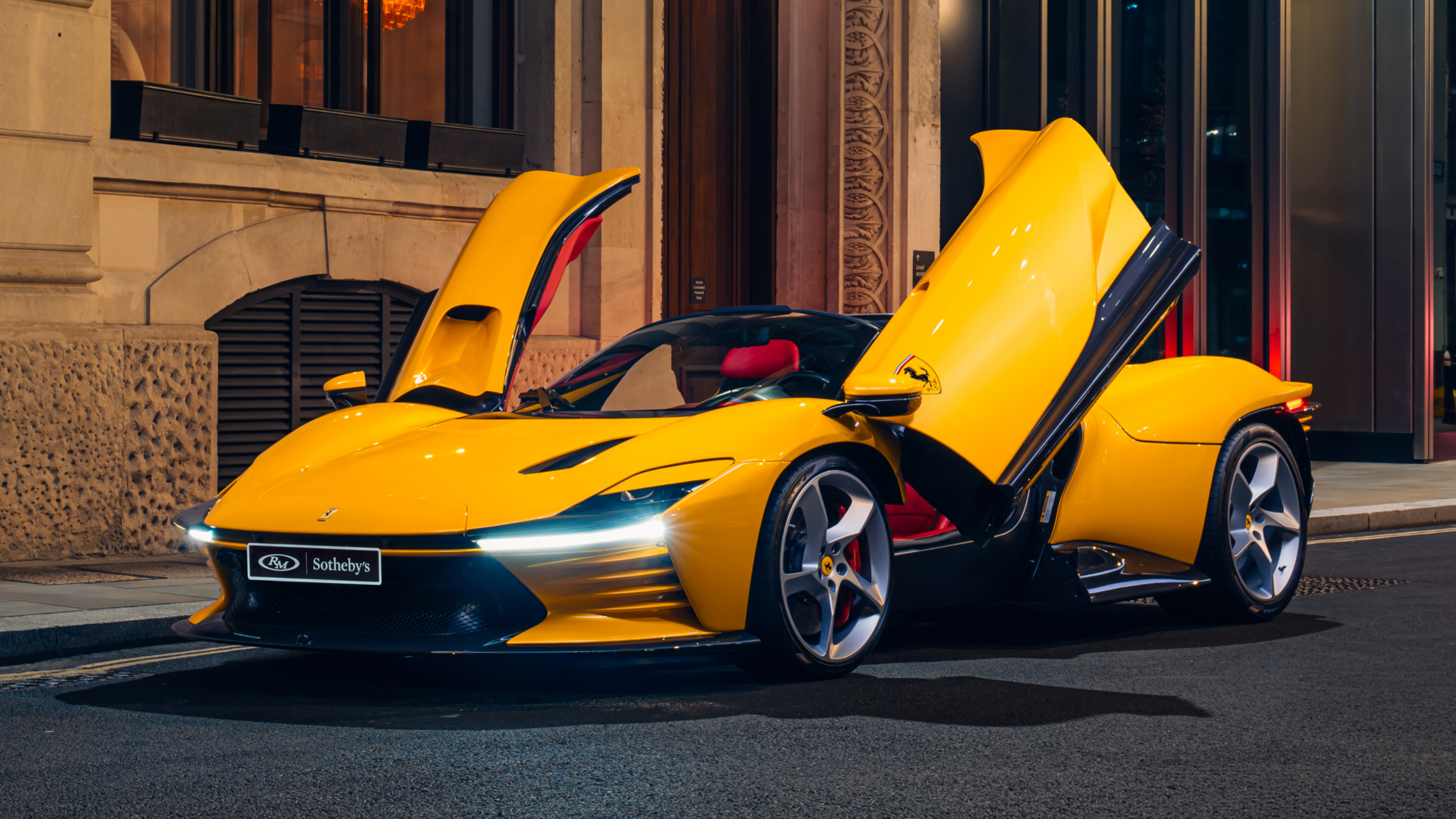
Now, a particularly significant example is preparing to take centre stage at auction. A former Ferrari factory development and press car, finished in an eye-catching shade of yellow, is expected to command between $10 million and $13 million at RM Sotheby’s London auction on October 31, 2026. Its estimated value reflects not only its mechanical credentials but also its unusual history as one of the cars that helped introduce the Daytona SP3 to the world. <Cite refs={[“turn618060search1″,”turn618060search6”]}/>
For collectors, this is more than an opportunity to acquire a remarkable automobile. It is a chance to own a piece of Ferrari’s contemporary history.
A Design Inspired by Racing Legends
Introduced as the third model in Ferrari’s exclusive Icona series, the Daytona SP3 was conceived as a modern interpretation of the legendary sports prototype racers that defined an important chapter in the company’s history.
Its inspiration can be traced to Ferrari’s celebrated performance at the 1967 24 Hours of Daytona, when the manufacturer’s racing prototypes achieved a memorable overall victory, finishing first, second, and third. The result became a defining moment for the brand and helped establish the Daytona name in automotive history.
The SP3 translates that heritage into a contemporary design language. Its dramatic proportions, muscular wheel arches, low nose, and flowing surfaces recall the purposeful beauty of classic racing machines while incorporating the engineering requirements of a modern road car.
One of its most distinctive features is the rear design, where horizontal elements and carefully sculpted surfaces create a dramatic visual signature. The bodywork appears almost architectural, with each line contributing to the vehicle’s sense of movement even when it is standing still.
Unlike many modern supercars that rely heavily on active aerodynamic systems, the Daytona SP3 employs carefully developed passive aerodynamic solutions. These include sculpted underbody channels and integrated features designed to manage airflow efficiently.
The result is an automobile that demonstrates how historical inspiration and contemporary engineering can work together without compromising the character of either.
The Power of a Naturally Aspirated V12
At the heart of the Daytona SP3 is a 6.5-litre, naturally aspirated V12 engine producing 829 horsepower. Derived from Ferrari’s celebrated V12 architecture, the engine represents an especially significant achievement in an era when electrification and turbocharging are increasingly common throughout the performance-car industry. <Cite refs={[“turn618060search0″,”turn618060search4”]}/>
The powerplant sends its output to the rear wheels through a seven-speed dual-clutch transmission, delivering the kind of immediate response and high-revving character that enthusiasts associate with Ferrari’s most memorable road cars.
Ferrari quotes a 0-to-62-mph acceleration time of approximately 2.85 seconds and a maximum speed exceeding 211 mph. These figures place the Daytona SP3 firmly among the world’s most capable modern supercars.
Yet statistics tell only part of the story. The appeal of a naturally aspirated V12 lies in the relationship between engine speed, throttle response, and sound. As the revs climb, the engine delivers a progressively more intense mechanical experience that differs from the character of many smaller turbocharged powerplants.
For enthusiasts who value traditional combustion-engine engineering, the Daytona SP3 represents a particularly significant expression of Ferrari’s capabilities.
A Striking Yellow Finish With Factory Provenance
The example heading to London carries a specification that distinguishes it from many other Daytona SP3s. Finished in Giallo Triplo Strato, an Italian designation referring to its triple-layer yellow paint, the car combines a vivid exterior with a Rosso Ferrari leather interior.
The contrast creates a dramatic visual identity. Bright yellow bodywork emphasises the car’s sculpted proportions, while the red leather cabin introduces a more traditional Ferrari aesthetic.
Carbon-fibre elements feature across selected exterior components, including the lower bodywork and removable hardtop roof panel. The overall configuration highlights the relationship between lightweight construction, performance engineering, and visual sophistication.
However, the specification is only one part of this car’s appeal.
What makes the vehicle particularly interesting is its history with Ferrari itself. Retained by Ferrari SpA after its construction in June 2022, the car served as a factory development vehicle and press demonstrator. It was subsequently acquired by its first private owner in March 2025. At the time of cataloguing, its odometer displayed 2,948 miles. <Cite refs={[“turn618060search1″,”turn618060search6”]}/>
That documented background gives the car an identity beyond its paintwork and mechanical specification.
The Supercar That Helped Tell Its Own Story
During its time as a factory press car, this Daytona SP3 appeared in reviews and media features produced by prominent automotive publications, including Car and Driver, Road & Track, and Motor Sport. It also appeared on the BBC motoring programme Top Gear in December 2022. <Cite refs={[“turn618060search0″,”turn618060search6”]}/>
Such exposure gave audiences an opportunity to experience the car through professional road tests, photography, and video coverage.
For collectors, this media history can create an additional layer of interest. The car is not simply a rare example of a limited-production Ferrari; it is also part of the story surrounding the model’s introduction and reception.
Its documented use by automotive journalists provides a connection to the broader enthusiast community. The vehicle helped demonstrate the SP3’s performance and design to audiences who might otherwise never experience such an exclusive machine in person.
Although press-car history can mean more mileage than a typical collector vehicle, it can also establish a distinctive provenance. In this instance, the car’s mileage remains relatively limited, and its factory background is an important part of its identity.
Why Collectors Are Watching the Auction
Ferrari’s Icona models occupy a particularly exclusive position within the company’s product portfolio. Rather than being ordinary production vehicles available to anyone who walks into a showroom, they are created in limited numbers and offered to a select group of established clients.
The Daytona SP3 was produced in a planned run of 599 cars, making access to an original allocation exceptionally difficult for enthusiasts who were not among the selected buyers. <Cite refs={[“turn618060search4″,”turn618060search5”]}/>
That limited availability has contributed to strong interest in the secondary market.
A further reference point arrived in August 2026, when another Daytona SP3 reportedly sold for $17.825 million at RM Sotheby’s Monterey auction. The car offered in that transaction was a different example, and the result demonstrates the extraordinary prices that individual Daytona SP3s can achieve under particular circumstances. <Cite refs={[“turn618060search2″,”turn618060search7”]}/>
The upcoming London auction nevertheless presents a different proposition. The car’s estimated value of $10 million to $13 million reflects its specific history, configuration, condition, and market positioning. An estimate is not a guaranteed selling price, and the final result will depend on bidding interest on the day.
For collectors, the auction will provide another important indication of demand for modern limited-production Ferraris.
More Than a Machine
The Daytona SP3 demonstrates that an exceptional automobile can exist at the intersection of engineering, design, heritage, and personal passion.
Its proportions celebrate the golden age of endurance racing, while its V12 engine preserves a mechanical experience that is becoming increasingly distinctive in a rapidly changing automotive landscape. Its limited production and carefully documented history add another dimension to its appeal.
The yellow factory press car carries a particularly interesting story because it was part of the process through which the Daytona SP3 became known to the wider automotive world. It has been driven, photographed, reviewed, and presented as an example of Ferrari’s contemporary interpretation of its racing legacy.
As it approaches the RM Sotheby’s London auction, the car stands as a reminder that some automobiles transcend their original purpose. They become objects of design appreciation, symbols of engineering ambition, and significant pieces of automotive history.
Whether the final hammer price falls within the published estimate or exceeds expectations, the sale will attract attention from enthusiasts who recognise the Daytona SP3 as one of the defining modern expressions of Ferrari’s V12 tradition.
For those who value exclusivity, performance, and a compelling story, this is a supercar that offers all three in remarkable measure.